
When my daughter was two and a half, teaching her to read was honestly not part of the plan.
I was in the thick of toddler life — navigating big emotions, cutting grapes into microscopic pieces, negotiating with a tiny human who had very strong opinions about snacks, trying to keep the house somewhat functional while running on very little sleep.
Teaching my toddler to read?
Honestly, that wasn’t even on my radar.
Reading felt like something that would naturally happen one day at school.
I wasn’t in a rush.
And yet… around that age, she started reading simple three-letter words.
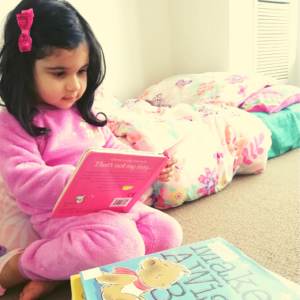
By the age of 4, she was wolfing down books.
We’d go to the library and come back with 40+ books that she would devour within a few days, begging for another trip to the library.
By age 5, she was confidently reading at third-grade level and flying through books faster than I could keep up with library trips.
I would have to literally beg her to come out of her reading corner.
People sometimes assume that means she must have been unusually gifted.
But that wasn’t it.
What changed everything was that I stopped focusing on “teaching reading” — and started focusing on something much smaller.
The Shift That Changed Everything
This post contains affiliate links which means I may earn a commission at no extra cost to you.
In the beginning, I did what I think most parents naturally do.
I assumed teaching a child to read meant learning the alphabet, recognizing letters, memorizing a few words and maybe playing around with flashcards here and there.
I wasn’t sitting down with my daughter trying to teach her reading — we were just playing around with letters and words whenever it felt natural.
Then I accidently discovered this reading program that completely changed the way I thought about teaching reading.
SOUNDS.
I learned about phonemic awareness — the ability to hear and work with the individual sounds inside words — and I remember thinking, Why has no one explained this to me before?
I learnt that before a child can look at CAT and read it, they first need to be able to hear that the word is made up of three separate sounds:
/c/ … /a/ … /t/
And then bring those sounds together:
c-a-t → CAT
That was my aha moment.
I realized I had been thinking about reading as something children see — letters on a page, words on a flashcard — when so much of the foundation actually begins with what they can hear.
And once I understood that, I started looking at teaching my daughter to read in a completely different way.
That was the missing piece.
And once I saw it, I couldn’t unsee it.
💛 If This Is Clicking For You…
If you’re suddenly thinking, “Ohhh… it’s about the sounds,” you’re exactly right.
That foundation is what makes everything else feel easy later on.
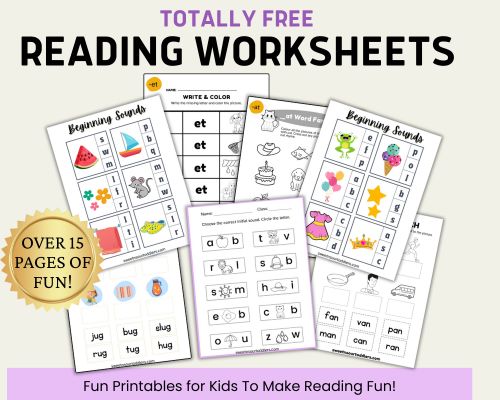
I’ve put together the same types of early sound activities we used when we were starting out — simple, playful worksheets that focus specifically on phonemic awareness and early blending.
You can grab them free below and start trying this at home:
But Let Me Be Honest About Something
It wasn’t just that I made a few flashcards and magically had a reader.
There is a very specific progression to building sound awareness so that blending feels natural instead of frustrating.
When children can truly hear and manipulate sounds, 3 letter words don’t feel like decoding a puzzle — they feel logical.
That’s why my daughter was able to start reading at at the age of 2.5.
That’s why at 5 years old she was devouring chapter books and reading far beyond her age.
Not because I ever pushed her to read, but because I focused on the right foundation and let everything build from there.
What It Actually Looked Like In Our House
We kept it simple — about 10 minutes a day.
I’d make little word cards on bright paper, and on the back I’d draw tiny pictures. She would slowly stretch the sounds out, blend them together, and then flip the card to see if she was right.
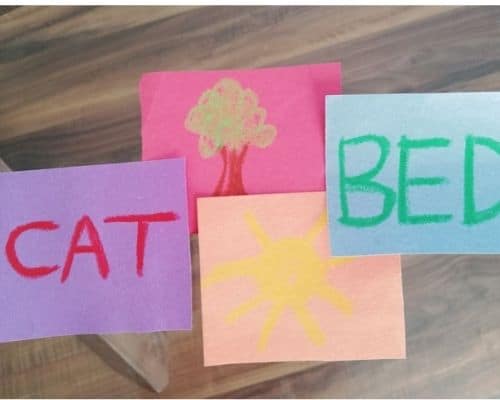
If she got it correct, we’d high-five and literally race across the room.
It sounds silly — but that playfulness is what kept her engaged.
Underneath the game, we were strengthening her ability to hear and manipulate sounds.
That invisible skill is what made reading visible.
💛 Want To Try This With Your Child?
And I get it — once you realize that sounds are such an important part of learning to read, it can almost feel like you have another question: Okay… but where do I even start? What sounds do I teach first? And how do I actually make this fun for a two- or three-year-old?
That’s exactly why I wanted to make this part really simple for you.
I’ve put together 20+ free early reading worksheets to give you an easy place to start, with activities that introduce these skills in a playful, manageable way — without overwhelming you or your little one.
Inside, you’ll find:
. Phonemic awareness activities
• Beginning sound practice
• Simple CVC blending
• Fun word family activities
They’re designed for real-life days — short, simple activities you can fit into 5–10 minutes without turning reading time into a chore.
Pop your email below and I’ll send them straight to you. 💛
One Last Thing I’d Tell Any Mom Starting This Journey
Don’t worry about how quickly your child is reading.
Don’t compare them to other children. And don’t feel like you need to turn every day into a lesson.
What made the biggest difference for us was keeping it playful, staying consistent, and giving my daughter the right foundation without making reading feel like something she had to do.
She was reading at 2.5, but honestly, what makes me happiest now isn’t the age she learned to read.
It’s watching her pick up a book and disappear into it.
That’s what I wanted for her all along.
And if you’re just getting started with your little one, I hope these worksheets make those first few steps feel a little easier.
Want to Take This Beyond the Worksheets?
The free worksheets are a great place to start, especially if you’re just discovering how important sounds are to learning to read.
But if you’re looking for a complete, step-by-step approach to teaching your child to read at home, there’s another resource I personally used with my daughter.
I used Children Learning Reading when she was little, spending just about 10 minutes a day with her.
It gave me a clear progression to follow instead of having to figure out what to teach next.
And it was the approach that helped my daughter go from those first little CVC words at 2.5 to reading fluently and confidently.
Leave a Reply